In short
Conversational lead qualification answers a visitor's question before collecting contact details, then adapts follow-up questions to signals such as fit, intent, authority, and timeline. Structured results can be written to a CRM, while separate funnel metrics and transcript reviews help teams identify and refine weak qualification steps.
Static lead forms are where interested visitors go to quietly give up. A well-built conversational flow does the opposite: it engages at the moment of intent, asks the right questions, and qualifies the lead before it ever reaches a salesperson. This is the playbook for doing that without turning your chatbot into an annoying pop-up.
Lead generation with AI chatbots is not about replacing forms with a chat bubble that asks the same five fields. It is about meeting visitors where their questions are, building enough context to qualify them, and capturing contact details as a natural next step rather than a toll gate.
Why Conversational Qualification Beats Static Forms
A form treats every visitor identically and asks for everything up front. A conversation adapts. It can answer the visitor's question first, earn the right to ask one of its own, and branch based on the answers. That reciprocity is why conversational lead capture consistently converts a higher share of engaged visitors than a cold form.
The other advantage is qualification. A form collects fields; a conversation collects signals. By the time a visitor has discussed their use case, budget range, and timeline, you know far more about fit than any form field would tell you.
Step 1: Detect Intent Before You Pitch
The fastest way to kill a lead is to ask for an email before you have helped. Start by detecting why the visitor is here. Are they researching, comparing, or ready to buy? A grounded assistant can answer their actual question first, which both builds trust and reveals intent.
- Researching: educate, link to relevant resources, no ask yet
- Comparing: surface differentiators, offer a comparison or demo
- Ready: capture details and route to sales quickly
High-intent behavior, like asking about pricing, integrations, or implementation timelines, is the cue to move from helping to capturing.
Step 2: Score the Lead as the Conversation Happens
Define a lightweight scoring model and let the assistant fill it in conversationally. Useful dimensions include:
- Fit: company size, industry, use case match
- Intent: buying signals, urgency, specific questions
- Authority: role and decision-making involvement
- Timeline: when they need a solution live
The assistant should collect these naturally across the exchange, not interrogate the visitor. Done well, a strong qualification flow has been observed to convert in the 15-30% range of engaged conversations, depending on traffic quality and offer. See how this played out in the real estate lead qualification case study.
Step 3: Sync Clean, Qualified Leads to Your CRM
A lead that lives only in a chat log is a lead lost. The conversation should write structured data to your CRM in real time: contact details, qualification score, captured fields, the source campaign, and a transcript summary. That lets sales pick up with full context instead of starting cold.
HoverBot supports this through native integrations, including HubSpot and Salesforce, so qualified conversations become CRM records automatically. The deeper mechanics are in the lead capture and qualification deep dive.
Step 4: Capture Leads Without Mishandling Data
Lead capture means handling personal data, which means privacy is part of the playbook, not an afterthought. A good platform masks PII before it reaches the model and keeps an auditable record of consent and handling. HoverBot does this by default; the approach is detailed on the PII masking chatbot page.
Step 5: Measure and Iterate
Track conversation-to-lead rate, lead-to-qualified rate, and qualified-to-opportunity rate separately. Most teams find their weak link is not the top of the funnel but the qualification step, where a flow that is too aggressive scares people off or one that is too passive lets unqualified leads through. Review real transcripts weekly and tune the questions and thresholds.
Where HoverBot Fits
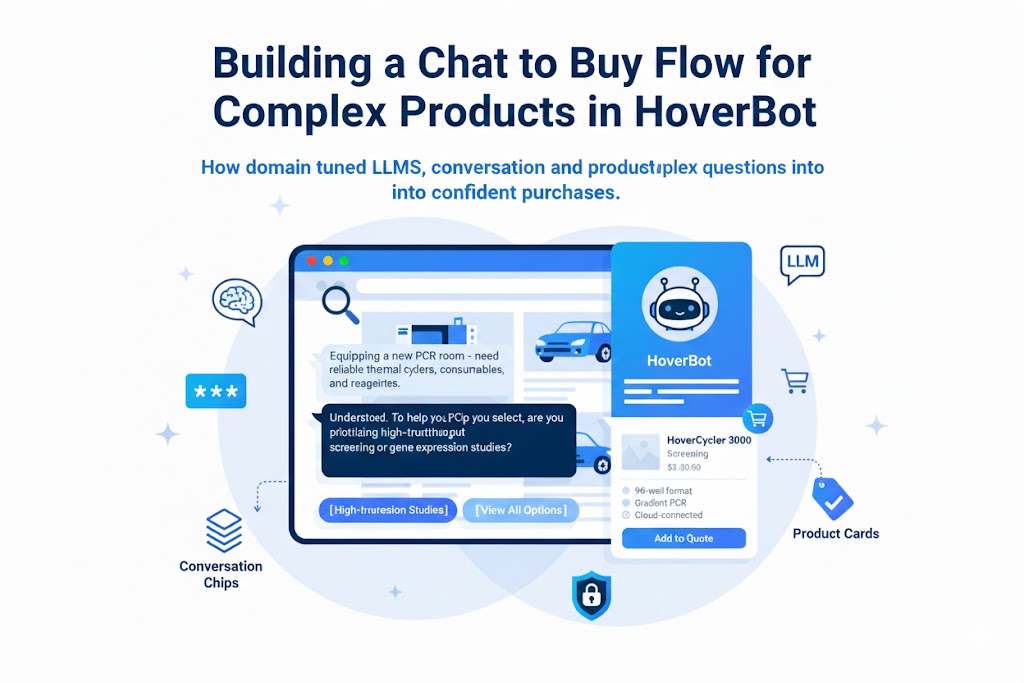
HoverBot combines grounded answers, conversational qualification, CRM sync, and compliance-first data handling in one platform. It can help a visitor, qualify them, and route a clean record to sales, all while masking PII and keeping the interaction auditable. For commerce teams, the same flows tie into the ecommerce solution; for high-consideration purchases, see how conversational selling works in chat-to-buy flows for complex catalogs.
Ready to turn more conversations into qualified pipeline? Request a demo and see HoverBot qualify and route a lead end to end.
Request a demoFrequently asked questions
- How should an AI chatbot qualify leads without annoying visitors?
- An AI chatbot should first detect whether a visitor is researching, comparing options, or ready to buy. It should answer the visitor's question before requesting information. Qualification signals such as company fit, buying intent, decision-making authority, and timeline should be gathered naturally throughout the exchange instead of through a rigid sequence of questions.
- When should a lead generation chatbot ask for contact details?
- A lead generation chatbot should request contact details after it has delivered useful information. Appropriate moments include after answering a pricing question or narrowing a product choice. At that point, sharing contact information feels like a continuation of the conversation. Pricing, integration, and implementation questions can indicate that the visitor has higher intent.
- What chatbot data should be sent to a CRM?
- A qualified chatbot conversation should send structured data to the CRM in real time. The record can include contact details, captured qualification fields, a qualification score, the source campaign, and a summary of the transcript. This gives the sales team context about the visitor's needs, fit, intent, authority, and timeline before follow-up begins.
- How should teams measure chatbot lead generation performance?
- Teams should measure conversation-to-lead, lead-to-qualified, and qualified-to-opportunity rates separately. Reviewing these stages helps identify whether the qualification flow is too aggressive or too passive. Teams should also review real transcripts weekly, then adjust questions and scoring thresholds based on where suitable prospects leave the conversation or unqualified leads pass through.
Sources
- Regulation (EU) 2016/679, General Data Protection Regulation · EUR-Lex
- Guidelines 05/2020 on consent under Regulation 2016/679 · European Data Protection Board
- Principle (c): Data minimisation · Information Commissioner's Office
- CRM API | Contacts · HubSpot
About the author
AI Product Engineering Team
Cross-functional team of AI engineers, product managers, and support operators building customer-facing chatbot systems in production environments. We ship weekly releases informed by production telemetry, closed-loop conversation reviews, and benchmark-driven evaluation cycles.
- Customer support automation and intelligent routing systems
- RAG pipeline design and guardrails for regulated workflows
- Operational analytics and closed-loop quality improvement
- Multilingual NLP and entity-level PII masking pipelines
- Production deployments across e-commerce, real estate, and SaaS verticals