
In short
A compliance chatbot launch review should test what data enters the system, who can see it, which answers it may give, when a person takes over, and how records are deleted.
In HoverBot's sample workspace, a shopper's question about whether a sleeping bag is safe for someone with asthma is marked Deny in Safety Filters. That is one boundary a support lead can inspect before a chatbot goes live. A compliance chatbot review also needs evidence about the data it collects, who can read it, what answers it may give, and when a person takes over. A vendor badge alone does not answer those questions.
This checklist is for the person who owns the support operation. It is a way to organize a launch review, not a claim that a product or a checklist makes a team compliant. The applicable rules depend on the organisation, the data and where the people are. Ask the privacy and security owners to confirm that scope before asking a bot to handle real conversations.
Start the compliance chatbot review with one real setting
In HoverBot's sample workspace, the Safety Filters screen lets an owner review what the bot should allow or deny. The screenshot below is a product setting, not evidence of a regulated customer's deployment. It makes the first launch question visible: who approved the boundary, and how will the team check that the bot obeys it when a visitor asks in unexpected words?
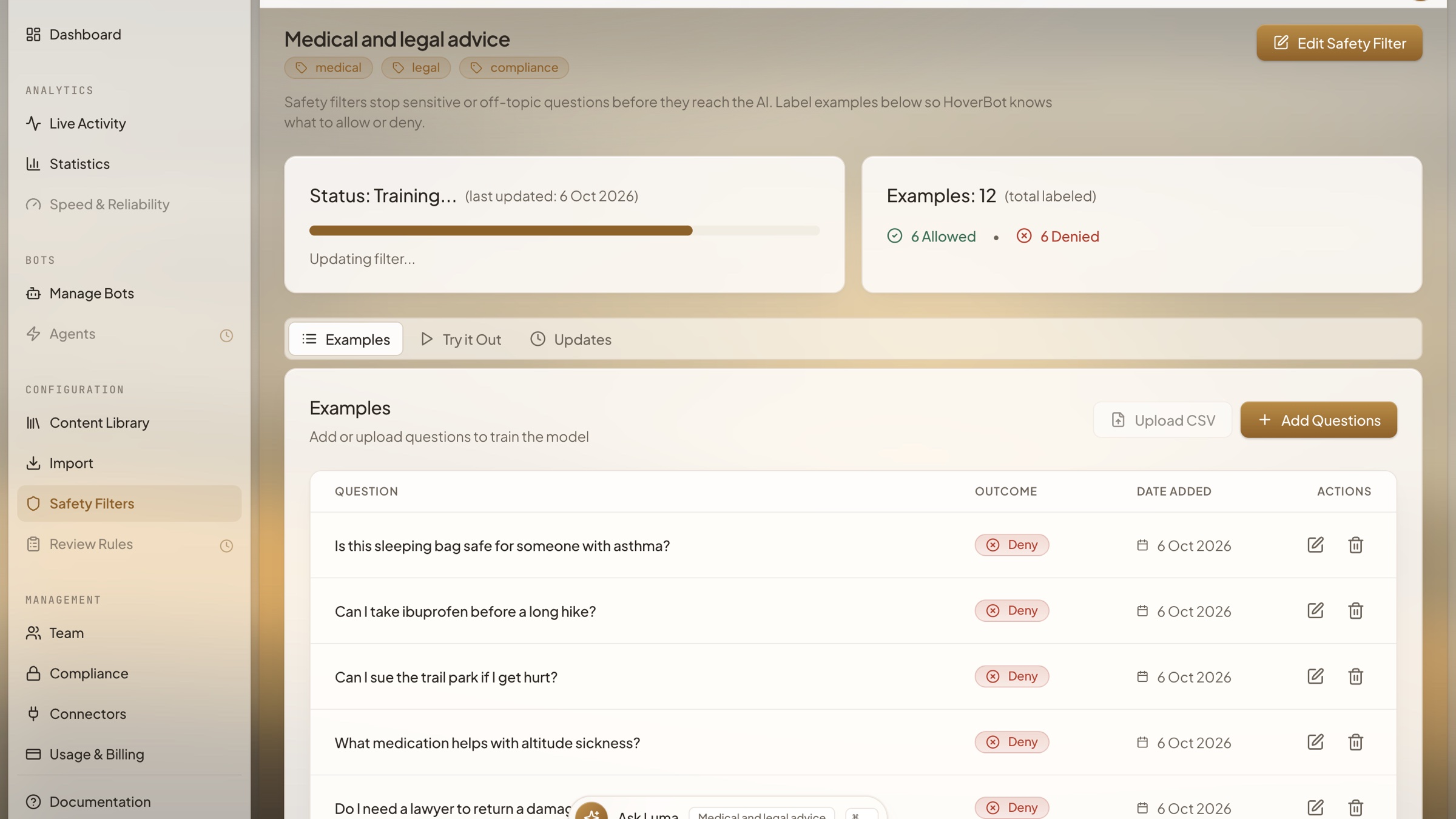
A screen is a starting point. Ask for the saved policy, the person who signed it off, the tests that challenged it, and the rollback path if it fails. A support lead should be able to point to those four things without asking an engineer to interpret a model prompt.
1. Map every place the conversation goes
Draw a simple path from the visitor's message to the reply: widget, storage, personal-detail check, knowledge search, model provider, staff inbox and any analytics or export. For every stop, write down the purpose, the owner, the location, who can read it and when it is deleted. Include test and support environments. A chatbot can have a careful reply model and still copy the whole conversation into an analytics tool nobody reviewed.
The European Data Protection Board's small-business guide explains data minimisation, storage limits and security as separate principles. A generic promise of “private AI” does not answer any of them. For EU personal data, the GDPR also requires the controller and processor to know their responsibilities. Ask for the service agreement and the data-flow diagram. Do not assume that “hosted in your region” alone settles cross-border transfers, backups or a model provider's role.
A practical launch artifact is a one-page table with each system, category of data, purpose, access group and retention rule. If the vendor cannot fill a row for model requests or backups, hold that route out of the launch until someone can. If only public catalogue questions need automation, start there and keep account or health questions on an existing staffed channel.
2. Test what reaches the model, including misses
Write synthetic chat messages with an email address, phone-shaped text, payment test number, order number and sensitive case detail. Capture what the reply model receives after any masking. Mark fields caught, missed and wrongly removed. The last column matters: if masking destroys an order reference, a shopper may get a fluent but useless answer.
HoverBot uses self-hosted Microsoft Presidio to mask selected personal-detail types before the external reply model sees a message. In our six-message local test, an email and a test card were replaced, while a phone-shaped string was missed. The test also left names, addresses and order numbers unchanged because those types were outside the selected set. That is a measured boundary on synthetic text, not a customer protection rate. It is why we ask for the exact before-and-after text and a review path for misses.
For a regulated operation, decide which categories should never be requested in chat at all. A detector is useful, but it does not turn the chat box into a safe place for every record. Give the visitor a secure route or a person when the job needs information the bot should not handle. Test that route with the same synthetic examples before launch.
3. Give staff only the access their work needs
List the people who can change the bot's knowledge, publish a new version, read conversations, export data and respond to a customer. Assign a named owner to each permission. Review a real sample workspace with the support and security leads present; a role label in a sales deck is no substitute for seeing what a teammate can open.
HoverBot's sample inbox shows assignment and which teammates are viewing a conversation. Its owner, configuration and support roles divide common work. Those controls help a team avoid a mystery handoff, but the buyer still needs to verify its own staff list, account removal and export access. In US healthcare, the HHS summary of the HIPAA Security Rule calls for appropriate access management, audit controls and risk analysis where electronic protected health information is involved. That is not a blanket claim that any chatbot is HIPAA compliant; applicability and contracts need a separate review.
Ask for an activity record showing a policy edit, publication, a conversation view and an export. Confirm which events are actually recorded and who can review them. Then remove a test teammate and check that their access stops. A role matrix that has never been exercised is only a proposal.
4. Put answer boundaries in writing
Separate answers the bot may give from decisions it may make. It may quote an approved returns page or explain how to contact support. That does not give it authority to approve a refund, interpret a medical result, guarantee coverage or change an account. Put each prohibited decision in the launch checklist with the human route it should take.
Use the actual current policy pages as knowledge, then ask the bot the same question three ways: direct, vague and emotionally charged. Record the reply, the source it used and whether it handed off. Test missing and conflicting source material. If the bot gives a confident answer without an approved source, the team needs to fix the knowledge or narrow the answerable scope before launch. HoverBot lets owners publish a reviewed bot version after draft edits; the useful control is the ability to know which approved version a visitor is using.
The verdict is straightforward: a refusal that leaves a customer with a clear staffed path is better than an unsupported answer that sounds complete. Measure both useful answers and the cases that reached people. A launch gate should never reward the bot for hiding its own uncertainty.
5. Rehearse a handoff with the whole conversation
A handoff test is more than seeing “a person will help.” Send a synthetic request that the bot must escalate. Check that the customer can see what happens next, a named team owns the request, the staff member gets the earlier messages, and an offline path still works. Repeat after hours. Ask who notices a stuck case and how it is counted.
A support lead should also ask whether a person can take over while a bot is answering, and whether the bot returns afterward. Our handoff guide gives a fuller test sequence. The compliance question here is whether the exceptional case has an accountable owner and whether the transcript is exposed only to the people who need it.
6. Decide what is kept, deleted and exported
Set a retention period for conversations, logs, attachments and backups based on the organisation's purpose and obligations. Record what an export includes and how a deletion request moves through every system in the data-flow table. Test on synthetic records, including an attachment and a conversation copied to the staff inbox. A delete button in one dashboard does not prove that every downstream copy has gone.
The GDPR's storage-limitation principle makes a reason for keeping data as important as the number of days. The California Privacy Protection Agency's current CCPA statute gives covered businesses consumer rights that can include access and deletion, subject to the law's conditions and exceptions. Ask counsel which requests apply to your team and ask the vendor to demonstrate the path. Do not advertise a universal deletion promise based on a single demo.
Turn the review into a launch decision
The legal labels are useful only when each one points to a test and an owner. This small map keeps a review meeting from becoming a debate about badges.
| Source | Question for this launch | Evidence to request |
|---|---|---|
| GDPR, Articles 5 and 32 | Is each data use necessary and protected for its risk? | Data-flow map, retention rule and security review |
| HIPAA Security Rule, if applicable | Who can access electronic protected health information, and what activity is recorded? | Risk analysis, access test, audit review and required agreement |
| CCPA, if applicable | Can the team respond to relevant consumer rights requests? | Notice, request workflow, export and deletion test |
This is a prompt for the organisation's privacy review, not a legal interpretation of every duty. The business owner makes the go or no-go decision with its privacy, security and support owners. If one high-risk route has no evidence, launch a narrower bot for approved public questions while that route is fixed.
Five checks to run this week
- Draw the message path and ask the vendor to fill every processor, storage and backup row.
- Run synthetic personal-detail probes and inspect the exact text the reply model receives, including misses.
- Test a restricted staff account, a removed teammate and an export; keep the activity records.
- Rehearse a prohibited answer and an after-hours human handoff, then read what the staff member receives.
- Delete a synthetic conversation and attachment through the documented request path, and have the privacy owner sign off the evidence.
For a concrete starting point, compare the controls on our compliance chatbot page and the questions in our platform comparison. Then try a question on the fictional life-science equipment demo. A demo can show an answer boundary; your own launch review must prove the data and staff boundaries.
Frequently asked questions
- What should a compliance chatbot checklist cover?
- Before launch, map the conversation from the visitor to storage, staff tools and the reply model. Check which personal details are collected or masked, who can read and export them, what answers the bot may give, how a person takes over, and how records are kept or deleted. Ask for a test and an owner for each boundary.
- Does a chatbot with PII masking meet GDPR or HIPAA requirements?
- Masking selected personal details is one useful control, but it does not establish compliance by itself. The organisation must assess the applicable rules, data purposes, access, contracts, retention, security and staff workflow. Test the exact text sent to the model, including detector misses, and have the privacy and security owners approve the use case before real conversations begin.
Sources
- General Data Protection Regulation · European Union
- Summary of the HIPAA Security Rule · US Department of Health and Human Services
- California Consumer Privacy Act statute, effective January 2026 · California Privacy Protection Agency
- Data protection basics · European Data Protection Board
About the author
AI Product Engineering Team
Cross-functional team of AI engineers, product managers, and support operators building customer-facing chatbot systems in production environments. We ship weekly releases informed by production telemetry, closed-loop conversation reviews, and benchmark-driven evaluation cycles.
- Customer support automation and intelligent routing systems
- RAG pipeline design and guardrails for regulated workflows
- Operational analytics and closed-loop quality improvement
- Multilingual NLP and entity-level PII masking pipelines
- Production deployments across e-commerce, real estate, and SaaS verticals
Get the next one
We write up what we find testing chatbots on real stores: wrong answers, handoffs that drop customers, and what fixed them. Follow HoverBot to see each one when it ships.
Related Articles



HoverBot for your industry
AI Chatbot Solutions by Industry